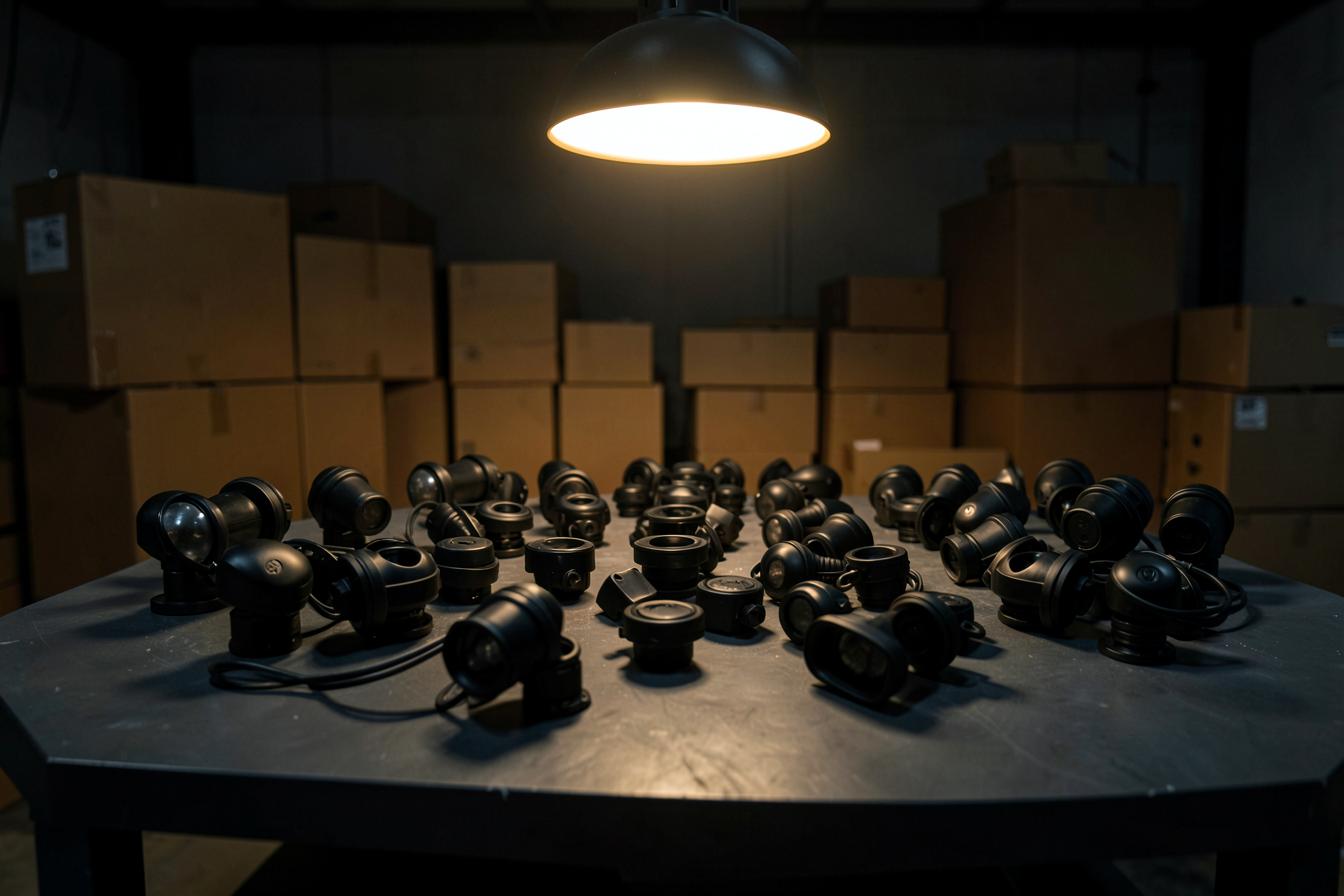
The Real Reason Lighting Contractors Lose Money on Fixture Procurement
The contractor rarely loses margin at purchase. The margin disappears between specification, quotation, approval, delivery and installation because nobody can prove what changed.
Take a lighting package quoted at INR 50 lakh with a planned gross margin of 15 per cent. On paper, the contractor expects INR 7.5 lakh. Then the project begins to move.
| Margin leak | Illustrative loss |
|---|---|
| Drivers, accessories and mounting components omitted | INR 1.20 lakh |
| Quantity difference between priced BOQ and approved drawing | INR 0.90 lakh |
| Control-protocol mismatch and replacement drivers | INR 1.10 lakh |
| Expedited freight after delayed approval | INR 0.75 lakh |
| Damage, site rework, replacement and warranty handling | INR 0.65 lakh |
| Finance, currency and extended credit-period variance | INR 0.50 lakh |
| Margin remaining | INR 2.40 lakh, or 4.8 per cent of package value |
The example is illustrative. The point is the pattern: margin is usually lost through accumulated scope and information gaps, not one spectacular buying mistake.
Contractors do not lose money when they buy the fixture. They lose it when nobody can prove what was priced.
Price is not the same as cost
A fixture quoted at ₹5,000 is not a ₹5,000 cost.
The real cost may include driver, accessory, track component, control interface, mounting sleeve, connector, freight, insurance, customs, tax, handling, sample, mock-up, storage, breakage, spares, credit period and site support.
When these items are not visible in the BOQ and vendor comparison, the contractor appears competitive at tender and discovers the real cost only after award.
Specification ambiguity creates commercial risk
A line such as “12 W recessed spotlight, 3000 K, black” looks clear until procurement begins.
What beam angle? What lumen output? What CRI? What colour consistency? What cut-out? What tilt? What driver? What dimming protocol? What ceiling thickness? What trim detail? What glare requirement? What finish tolerance?
Every missing detail becomes a future interpretation. If the consultant, vendor and contractor interpret the line differently, somebody pays for the gap.
Substitution is where margin and design both get damaged
Substitution is not automatically bad. It can solve budget, lead-time or availability problems. The problem is approving an alternative without comparing the complete system.
A lower-cost luminaire may need a separate driver, different cut-out, additional accessory or more units to achieve the same result. A similar lumen output may have a different beam, lower optical efficiency or higher glare. A different dimming method can force a control change across the project.
The unit rate falls, but the installed cost rises. At the same time, the design quality is weakened and the contractor is blamed for the result.
Missing components are rarely small
Drivers, end caps, joiners, suspensions, connectors, mounting channels, emergency packs and control modules are often treated as minor accessories. Across a large project, they can become a major percentage of the package.
Linear lighting is a common example. The rate may be compared per metre while the actual system cost depends on profile, diffuser, LED board, driver loading, feed points, joinery detail, corners, connectors, mounting labour and wastage.
The BOQ should price the installed system, not the visible light source.
Approvals and revisions consume the margin
A contractor may price one product, submit another, mock up a third and finally procure a fourth because the original approval process was not controlled.
Each cycle takes engineering time, samples, courier cost, meetings and revised quotations. If quantities change while the approval is running, vendor discounts and minimum order assumptions can change too.
Without a locked revision reference, the contractor can end up buying against an old drawing and defending the quantity against a new one.
Lead time turns technical gaps into expensive decisions
Late product approval compresses procurement. The project then pays for air freight, split shipments, local temporary fixtures or whatever alternative is immediately available.
The contractor may absorb the premium to protect the programme, especially when the tender excluded a clear approval deadline or variation mechanism.
A procurement schedule should therefore begin with the design programme, not after the purchase order. Critical fixtures, custom finishes, controls and long-lead components need approval dates tied to the construction sequence.
Site reality creates another cost layer
Fixtures arrive and the ceiling detail is different. The recess depth is unavailable. The driver has nowhere accessible to sit. The joinery opening is wrong. The control cable was not pulled. The façade bracket cannot be installed. The landscape sleeve is full of water.
These are described as installation issues, but many begin as coordination gaps between design, BOQ, shop drawing and procurement.
A technically correct product can still become an expensive site problem when the mounting condition was never validated.
A procurement-ready release gate
| Before purchase order | Evidence required |
|---|---|
| Scope baseline | Approved BOQ and drawing revision with exclusions and assumptions |
| Technical approval | Exact product code, photometry, dimensions, driver, control, finish and accessories |
| Substitution approval | Side-by-side technical equivalence and installed-cost comparison |
| Commercial approval | Rate, taxes, freight, currency, validity, payment terms, lead time and warranty |
| Installation approval | Cut-out, depth, mounting detail, access, cable, controls and site readiness |
| Logistics plan | Release date, delivery sequence, storage, receiving, damage process and spares |
| Handover trail | Commissioning, aiming, warranty and replacement history |
The connected procurement layer
A contractor should be able to follow one product row from specified item to priced item, approved item, purchase order, delivered item and installed item. At every step, the system should show what changed, who accepted it and what that change did to cost and performance.
That is where Alya can become commercially useful. Not as another procurement ERP, but as the lighting-intelligence layer connecting design evidence, BOQ, vendor comparison, substitution, approval and project revision.
Margin protection begins with information design.
Fix the continuity between specification, quotation, approval and site, and the procurement conversation becomes calmer, fairer and far more profitable.
Primary Sources and Fact-Check Notes
- DALI-2 overview Reference for control interoperability.
- DALI Alliance certification Useful for certified-product verification.
- ANSI/IES LP-16-22 Reference for explicit control scope.
- ANSI/IES LM-63-19(R25) Reference for traceable photometric data.
Fact-checked 25 August 2026. Confirm the adopted standard and local requirements for each project.