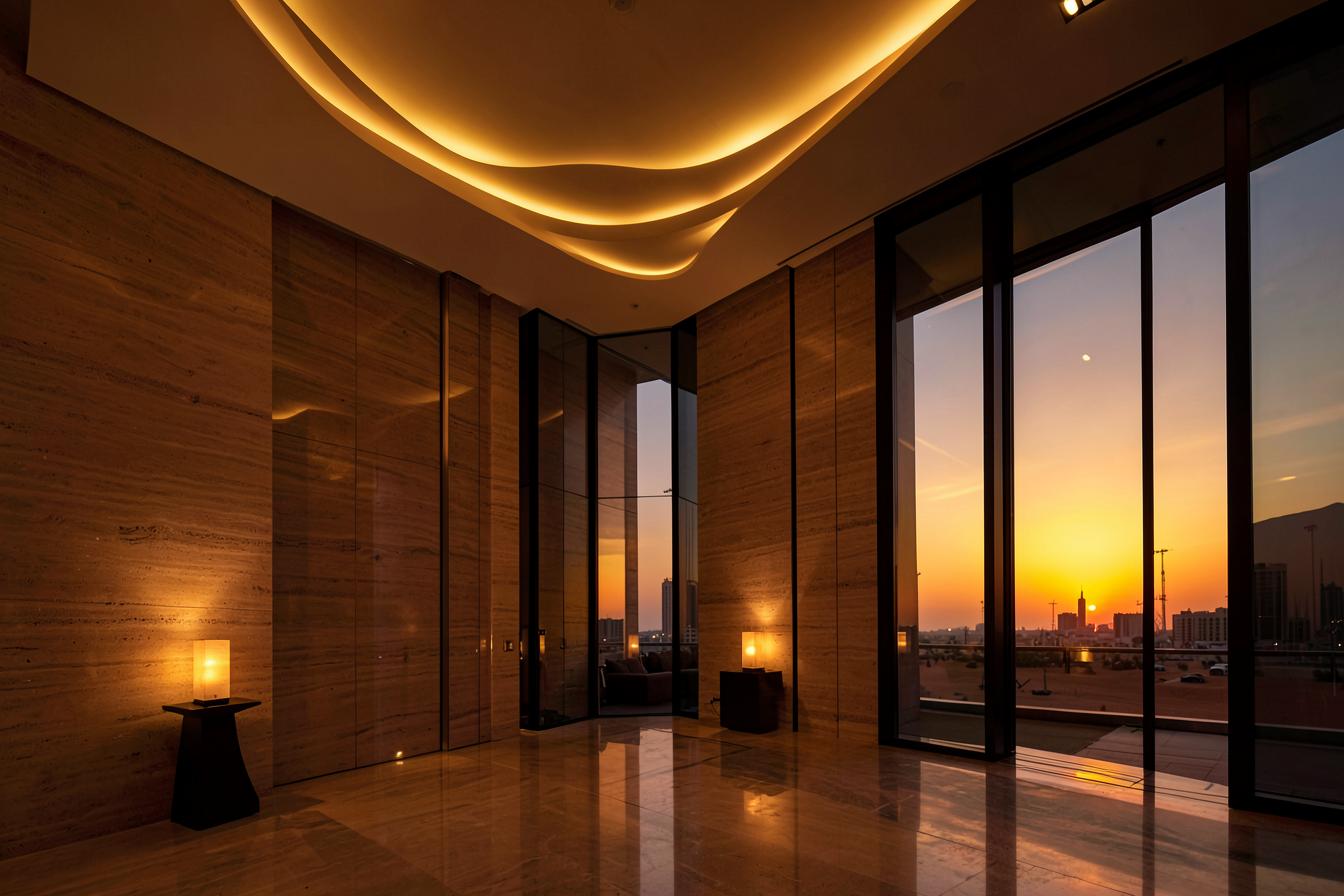
Hospitality Lighting in Dubai: What Changes, What Does Not, and What You Cannot Ignore
Dubai does not require different physics. It requires global lighting principles to survive extreme daylight, local code, guest expectations, outdoor conditions and a fast procurement environment.
Dubai does not require a different physics of light. It requires a different level of discipline.
The fundamentals do not change at immigration: visual hierarchy, glare control, colour quality, scene design, maintainability and respect for architecture. What changes is the context pressing against them.
Luxury is not fixture quantity. In Dubai, that mistake simply becomes more expensive and more visible.
The code layer is not optional
Al Sa’fat is Dubai’s green-building system for new buildings. Its mandatory requirements connect lighting design to the Dubai Building Code, including interior and exterior lighting power density, lighting controls, daylight provisions and control systems for hotel rooms.
That means a hospitality concept cannot be developed only through mood images and decorative fixture selections. The scheme must also fit connected load limits, control requirements, daylight strategy and the wider building-services design.
The best time to solve this is during concept design. The worst time is after the ceiling, control system and fixture package have already been tendered.
The transition from daylight to interior light is more demanding
Dubai’s exterior brightness can be extremely high. A guest entering a lobby, restaurant or retail-hospitality space may move from intense daylight into a deliberately warm, low-lit interior within seconds.
If the entrance sequence is handled badly, the interior can initially feel too dark even when the maintained light level is appropriate. The response should not be to flood the entire lobby with more light. It should be to design adaptation through the arrival canopy, vestibule, façade shading, lobby threshold, surface brightness and layered vertical light.
The eye reads bright surfaces before it reads a lux report. A well-lit wall, artwork, reception face or ceiling volume can guide adaptation more effectively than a uniform grid of higher-output downlights.
The climate changes product decisions
Exterior and semi-exterior luminaires must survive heat, dust, humidity and, in coastal conditions, corrosive exposure. Ingress protection matters, but IP rating alone is not a complete durability strategy.
Driver temperature limits, thermal management, gasket quality, cable entry, material finish, coating, lens ageing, mounting detail and access for maintenance all matter. A product that performs well in a temperate catalogue image may fail early when installed inside a hot niche, exposed cove or unventilated façade detail.
For landscape and façade lighting, the design team should review the product together with the installation condition. Heat dissipation and drainage cannot be solved by the luminaire datasheet if the detail itself traps heat or water.
Hospitality is an operating system, not one scene
A hotel does not have one lighting condition. It has arrival, daytime lobby, evening lobby, events, housekeeping, cleaning, late-night circulation, emergency operation and maintenance.
Restaurants need breakfast, lunch, pre-dinner, dinner, private event and cleaning scenes. Guest rooms need intuitive control, not a wall full of unexplained keypads. Ballrooms and flexible venues need scenes that can be recalled by staff without calling a programmer every time the furniture moves.
The control narrative must therefore be written around operations. Who uses each scene? What happens after midnight? Which circuits are manual? Which are scheduled? What remains on for safety? What does housekeeping need? How does the guest override the room without destroying the intended sequence?
Dubai’s Al Sa’fat framework also points directly to control systems for hotel rooms, making this both an experience question and a code-coordination question.
Luxury is not fixture quantity
Dubai hospitality projects can fall into a familiar trap: more decorative fixtures, more feature lights and more brightness are assumed to create a more premium result.
Real luxury is control. It is a lobby where the architecture feels effortless, a restaurant where faces and food look right, a guest room where the controls make sense and a façade that is recognisable without becoming visual noise.
Darkness is part of that control. Contrast, shadow and selective emphasis create value. A ceiling filled with expensive luminaires can still produce a cheap visual experience if every surface is competing for attention.
Procurement needs to be designed early
Many hospitality fixtures are imported, customised or finish-sensitive. Lead time, mock-up approval, driver availability, dimming compatibility, local support, spare strategy and replacement continuity should influence selection before tender.
A substitution made to recover programme can change beam quality, colour consistency or dimming performance across hundreds of rooms. The commercial decision must therefore refer back to the original lighting intent and approved sample, not only the fixture schedule description.
Guest-room scenes should be obvious, not impressive
| Scene | What the guest should experience | What the system must do quietly |
|---|---|---|
| Arrival | Warm orientation and enough vertical light to read the room | Recall a stable default scene regardless of the previous guest |
| Relax | Lower ambient light with comfortable focal layers | Dim compatible drivers without flicker or drop-out |
| Work / read | Useful task light without flattening the room | Provide local control and preserve the rest of the scene |
| Night | Safe movement with minimal disturbance | Use low, shielded light and simple bedside access |
| Master off | Confidence that the room is actually off | Coordinate decorative, joinery, bathroom and plug-in layers |
| Housekeeping | Full visibility for cleaning and inspection | Provide a service scene without confusing the guest interface |
What this means for Alya Studio
Alya should carry local requirements, room-type templates, scene logic, fixture evidence, mock-up decisions and approved substitutions inside one project history. The value is not a generic "Dubai mode." The value is remembering which local constraint changed which design decision.
Dubai does not need more light. It needs better editing, better controls and better continuity from concept to site.
A strong design absorbs daylight, heat, code, operations, guest expectations and procurement pressure, then makes the experience feel effortless.
Primary Sources and Fact-Check Notes
- Al Sa'fat, Dubai Green Building System Official Dubai Municipality overview.
- Al Sa'fat, 2nd edition, January 2023 Official system document.
- DALI-2 overview Reference for interoperable controls relevant to hospitality scenes.
- ANSI/IES LP-16-22 Reference for control narratives and sequences.
Fact-checked 25 August 2026. Confirm the adopted standard and local requirements for each project.